In this case
01 Designing a Global Platform for the Leader in Sports
02 A Platform Built to Absorb Change
03 One ESPN Product, On The Best Available Screen
04 Editorial Leadership and Trust
05 Editorial Authority in a Fragmented Media Environment
06 Aligning TV, Video, Identity, and Product Systems
07 Audience Gravity and Monetization
08 Platform Evolution Without Reinvention
09 Outcome
Designing a Global Platform for the Leader in Sports
ESPN operates as a public-facing product where trust, accuracy, and reliability mattered every day. Fans depended on ESPN for scores, news, analysis, video, and context across many sports and moments. Failures were visible immediately and carried editorial, brand, and revenue consequences.
I held senior design leadership roles at ESPN for 13 years, working within the core editorial and product leadership group responsible for ESPN.com and its primary platforms. My responsibility spanned product design, editorial design, experience strategy and UX research, and cross-surface integration across TV, web, mobile, video, and identity.
During several periods of growth and strategic change, my role evolved and icluded oversight of international design to leading standards, systems, and cross-team alignment in partnership with regional directors, broadcast creative and marketing leadership, and product teams.
The mandate was not to chase moments. It was to build a platform that could endure change without losing confidence or clarity.
A Platform Built to Absorb Change
Over multiple product evolutions, ESPN faced continuous shifts in formats, surfaces, and expectations. The challenge was not predicting each change, but designing a system that could absorb it without constant reinvention.
Under my leadership, the platform was structured around durable foundations with flexible surfaces. Feed-based experiences supported velocity and discovery, while purpose-built destinations for teams, leagues, scores, schedules, and statistics remained stable and learnable. This balance allowed ESPN to evolve how content was presented without destabilizing what fans relied on.
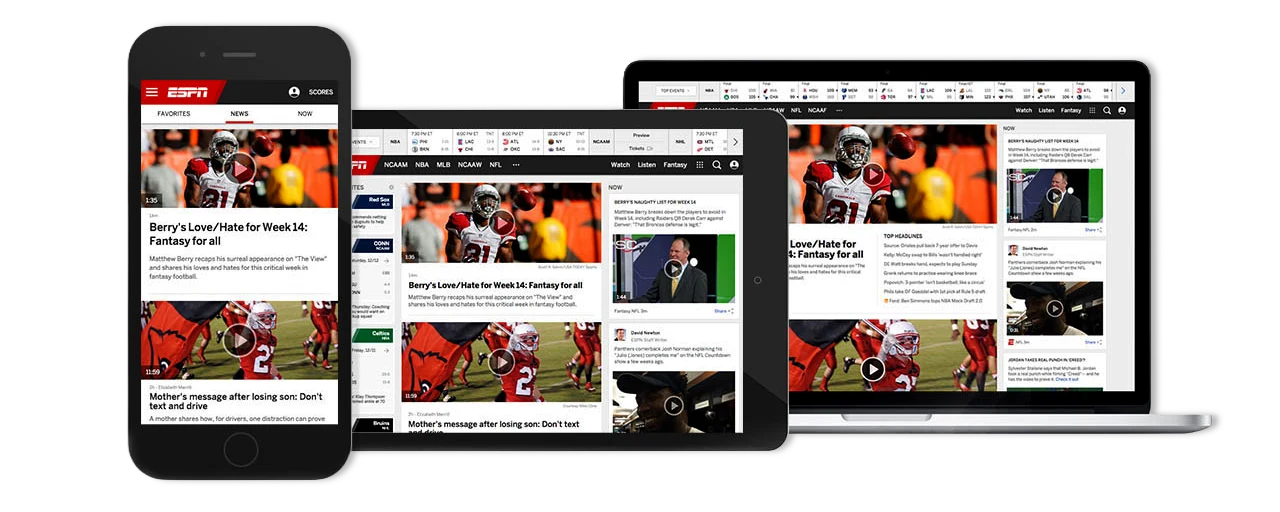
One ESPN Product, On The Best Available Screen
ESPN functioned as a single product expressed across TV, web, mobile, audio, and Connected TV.
Fans moved fluidly between screens, watching games, listening to coverage, tracking scores, and reading analysis. Each surface served a distinct role, but all needed to feel familiar and connected. Continuity mattered more than visual sameness.
I led the development of shared design systems, data models, and interaction patterns that preserved coherence across screens while allowing each experience to do what it was best suited for.
Editorial Leadership and Trust
ESPN’s value was not only speed. It was judgment.
Design decisions reinforced clarity, hierarchy, and context so breaking news, analysis, and live data could coexist without confusion. Editors needed flexibility to lead coverage while operating inside systems that preserved accuracy and integrity.
Trust was treated as a product constraint, not a byproduct.
Editorial Authority in a Fragmented Media Environment
As sports media decentralized, ESPN faced growing competition from social platforms, direct team and league channels, independent blogs, and emerging audio voices. Breaking news increasingly surfaced outside traditional publishers, and fans could follow athletes and commentators directly.
I worked closely with editorial and product leadership to ensure the platform balanced immediacy with structure, reinforcing credibility and context while remaining relevant in real-time conversation.
Aligning TV, Video, Identity, and Product Systems
ESPN’s strongest leverage came from aligning broadcast, product, and marketing systems rather than operating parallel channels.
I led initiatives to simplify and unify account systems as authenticated viewing and video became core to the experience. This included consolidating multiple user identities, improving sign-in flows, and aligning ESPN identity with Disney authentication standards to support legal, age-based, and policy requirements. The work improved the fan experience while enabling personalization, marketing, and targeting across products.
In parallel, I partnered with TV creative and marketing leaders to establish shared standards and reduce redundant asset production. Team logos, photography, and player headshots were centralized across professional and college sports, with systems designed to remain accurate as rosters changed continuously.
Audience Gravity and Monetization
By building a trusted, habit-forming destination for sports fans, ESPN created one of the most engaged audiences in media. That audience gravity drew the attention of brands seeking to speak to fans in moments of passion, loyalty, and attention.
Advertising remained foundational, while ESPN Insider, paid Fantasy products, magazine subscriptions, and video-based sponsorships reinforced one another. My work ensured commerce integrated naturally into core experiences rather than isolated flows.
Monetization followed engagement and trust.
Platform Evolution Without Reinvention
As consumption patterns matured and new surfaces emerged, the platform continued to evolve. Feed-based consumption, app alignment, system-driven design principles, and responsive thinking extended the experience without replacing its foundations.
Later evolutions raised the ceiling rather than correcting failure.
Outcome
ESPN remained a category reference point through years of change. The platform supported editorial leadership, cross-surface continuity, evolving monetization, and global reach without frequent reinvention.
Later platform evolutions were framed internally as extensions of a system that had already proven durable through sustained growth, new devices, and shifting consumption patterns.
The work established a foundation that allowed ESPN to keep changing while remaining recognizable, trusted, and commercially relevant.